Monday, July 6, 2026

Proposed Project for Evacuation Remembrance.


Imagine this is an image of paper boats floating in the East River with a backdrop of Lower Manhattan.

I have had an idea for a public art project for a number of years. It came to me around that time I was photographing areas of Brooklyn that were associated with the Battle of Brooklyn. I was using pinhole cameras and other primitive photographic techniques. To capture the landscape as it appears today. I was interested in documenting the changes of the landscape since the battle. I photographed the old stone house, and in Greenwood cemetery. Areas where the battle took place. One such part of the battle story was the evacuation of the American army from Brooklyn to Manhattan. Today the area of Fulton landing where the event happened, is a favorite tourist spot with majestic views of lower Manhattan. I came up with a photo project that I could do that referenced the event. However the more I thought about it the more I thought it could become an art public event. I could see family and general members of the public participating. Perhaps it could become a yearly event.

Paper boat example

Background- After the fighting around south Brooklyn on August 26,1776. The British and American armies paused and consolidated their positions. General George Washington, realized that his army was trapped with its back to the East River. If the British army attacked again he may be forced to surrender the whole of his army. Fortunately, rain and bad weather moved in, covering NY harbor with dense fog. Washington, seeing this as his opportunity, decided to retreat across the East river from Brooklyn to Manhattan. On the night of August 29/30 1776 with the help of hundreds of small boats and experienced whaling sailors from Massachusetts. Washington was able to successfully evacuate the entire army to Manhattan before the British found out they were gone. Thus saving the new American army from capture and destruction. So that they may live to fight another time and eventually win independence.


My idea is a way to commemorate this historical event. Simply I would construct small boats out of folded paper. Like above. Much like children do. It would be nice to put candles or simple lights on them. Like I've seen with water lantern festivals in Asia. See latern pictures for reference. These simple boats could then be launched from Pebble Beach that is located between the Brooklyn and Manhattan bridge. See map below. This place is close to Fulton Ferry and best of all it provides direct water access. The fragility of the paper boats represents the fragility of the new America and the first battle of the American Army. The light has many different condemnations, freedom, remembrance, etc.


This could become a yearly family event at sunset or later. People would make their own paper boats and launch them into the waters of the small bay at Pebble Beach. It would be a fantastic image with numerous illuminated small paper boats with the Manhattan skyline as a background. I don't know how the boats would be recovered or if they sank. Maybe if only paper it wouldn't be too much of a pollution risk. People could be on kayaks stationed in the water and could fish out boats before they moved to the open water of the East river. 


This year is the 250th anniversary of the battle. It is too late to organize such an event so it is just a thought for the future if anyone is interested in organizing something like this. I guess it would require coordinating with park officials etc.


Friday, July 11, 2025

100 Paintings in a bag. "100 Poppies 1914-2014"

 Digging through some old pictures on my hard drive. I came across a project that I did back in 2021. With this project I revisited a work that referenced both calendar time and the seasonal time of nature. I had done a bunch of paintings in 2014 that attempted to link the 100 years between the start of World War one in 1914 and the time of my exhibition to the Box gallery in 2014. The largest work in the exhibit was entitled “100 Poppies 1914-2014”. It was 16’ by 5’. I graphically created a grid of poppies flower images that were 20 across and five rows high. The poppies aged and lost color as they progressed backwards through the time grid. The last four symbolize the war years being charred and black with charcoal. I have an older blog post about this work.

Thinking about this concept of an aging poppie image repeated one hundred times. I thought about reducing the painting size into a more manageable scale. I came up with 4” x 4” size plywood pieces that can then be arranged into a grid pattern. The finished work is 40 inches square. The smaller scale was a little more manageable.


I realized that I didn't have to mount the individual squares unless I was going to exhibit it. The one hundred squares fit conveniently in a bag or a plastic bucket. Solving the pressing storage issue. These paintings continue to remain in buckets and bags waiting to be exhibited one day.

Below is two versions of "100 Poppies 1914-2014" 40"x40"


The first one is a painted version. With drawn and painted poppies images. 

40"x40" Paint and Charcoal on 4" square plywood panels

The second version. Is a little more elaborate. Here I used soil as a background for paper poppies.

40"x40" Earth, Paper on 4" plywood panels

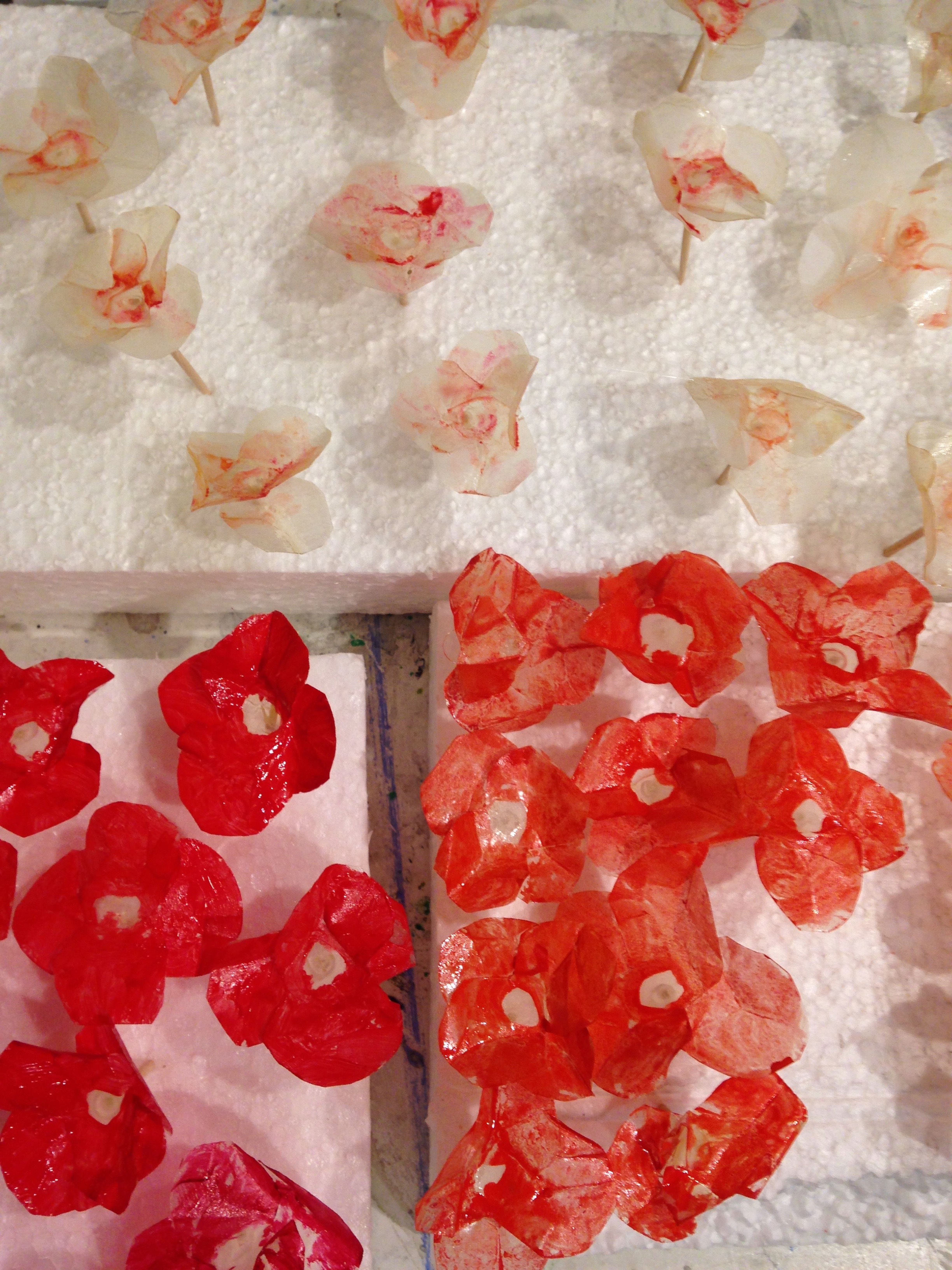
Below are some pictures from the creation process.


Flowers are made from mulberry paper that was then coated with a clear shellac before painting


Different color earth was used to create a surface for mounting the paper flower. The earth was collected by me from various battlefields.


.


Thursday, June 26, 2025

Convoy PQ17 ( Azerbaijan)

Convoy PQ 17 was one of the Arctic convoys, a series of vital supply routes during World War II that delivered essential war materials to the Soviet Union via northern Russian ports. The route to Murmansk and Archangel was particularly hazardous due to German naval and air forces, as well as the harsh Arctic weather and ice conditions. Convoy PQ 17 suffered heavy losses, with only 11 out of 35 merchant ships reaching their destination. 
The Soviet tanker Azerbaijan was part of Convoy PQ 17, which sailed from Iceland to Murmansk and Archangel in the Soviet Union during World War II. The convoy, which aimed to deliver supplies to the Soviet Union, faced heavy attacks from German U-boats and aircraft, resulting in significant losses. The tanker Azerbaijan, despite being damaged by a torpedo, managed to make it to port with the help of its crew, including the mainly female crew who fought to save the ship. The actions of the crew, particularly the female members, in saving the tanker were considered heroic in the face of adversity. 
I created these small paintings on some scrap wood that had random paint applied. Normally cut off scraps like this end up in the bin. However- I found the random paint color and splashes compelling and evocative in some way. So I held on to these for a couple of years waiting for this project to come along.
5"x7"
4"x8"
4.5"x4.5"

Nude Landscapes

 Playing around with a prompt from my daughter. 

I originally envisioned these nude laser transfer image paintings as stand alone images. I feel that they still can. I just need to come up with a framing method. Currently they are on thin wood panels.

But taking her suggestion I assembled them into one composition. I have enough of them to create three separate larger works. I made a rudimentary attempt to arrange a flow and pattern with them.


34"x33"

44"x34"

34"x33"


Wednesday, May 14, 2025

Hall of Gowanus Exhibit


Last month I was in a group show Hall of Gowanus.I was asked to show some older work. It was fun to see the work and to reunite with local artists.  I want to thank Sasha Chavchavadze for inviting me. There have been so many rapid changes to the Gowanus neighborhood in the last 5 years. Below are some pictures from the exhibition.


Maryland Willow of the Gowanus. See older blog posts for detailed information about this work.


Three pinhole camera photos of some Brooklyn historical sites.


Friday, June 28, 2024

Dog Woods


This series evolved out of my work with expired house paint. I had made a number of panels using expired house paint. See a previous post about that process. I had always thought of some of them as a painted background, meaning I would paint something else on top of the image that I was achieving with the house paint. I felt that even though some of them were turning out quite beautiful on their own, that I perhaps needed another pictorial element.

As spring rolled around, the dog woods started to bloom. They are such a large and simple and numerous flower. Their delicate white color stands in contrast to the fresh green of the tree's leaves. I thought that these flowers might make a good pattern to add against the vertical background of my expired paint experiments.


My process was to pick some of the flowering dogwood blossoms and photograph them. After adjusting the contrast in photoshop and sizing them. I printed them with the laser printer.The paint is applied using the cut out paper as a stencil. After the painted shape of the blossom dried I added the delicate lines of the laser print photograph on as a top layer.


Figurative Landscapes


This series came about because a student assistant had mixed up too much of this flesh toned color. They kept adding more and more paint together in an effort to get a different color. In the end the student abandoned the attempt and left a half gallon of this color setting on the mixing table unused. Me, being the studio manager, not wanting to discard the large amount of paint, set it aside hoping another project might come along where that paint might be useful.


Thinking that the color reminded me of flesh, I wondered if I could use it that way. First I tried to use it as a flesh tone and experimented with painting a figure. However the paint did not mix well with other paints. And I just wasn't finding anything with that approach that ultimately interested me. Working with some photographs I had taken that had been enlarged. I became interested in the abstract forms that the human body and skin can make. While not necessarily identifying any particular area of the body. The resulting images became abstracted landscapes of sorts in my mind. The flesh tone of the paint reinforces the essence and further references the human form.


I used laser print transfer to add a photographic line element. I also set the flesh tone against a dark background. Letting the two colors blend and merge with the print. The effect reminds me of an early wet plate photographic process.


All the paintings are 8.5 x11 inches. On a wood panel. 2024.