Saturday, September 11, 2010

Pin Hole Panorma Views of Battle Pass Brooklyn


Path leading to the right flank of the American position next to the Flatbush Road.


View from above the pass looking east from the American line.
View of the Left flank above the pass.
View looking West from below the right American flank


Saturday September 3, I was able to take advantage of perfect weather and take some pinhole photographs of Battle Pass in Prospect Park, Brooklyn. It was the sight of a short battle between American troops under the command of Major Gen. Sullivan on August 27, 1776. Sullivan's troops were posted across the top of this ridge. The goal was to block the movement of British & Hessian troops towards the ferry landings in Brooklyn. Up the center of the ridge ran the Flatbush Road a major roadway that connected Brooklyn with the outlying settlements of Flatbush. Sullivan, thinking he could hold his own in this strong position was ultimately out flanked on his left. English troops advancing down the Jamaica Road, in a great flanking maneuver, surprised the American holding the pass. Once the English troops got in behind them, the American defense crumbled and the troops fled down hill toward the Gowanus Canal.
The film was 400 speed T-Max, developed in D-76 1-1. My average exposure time was about 9 to 14 sec. However I usually hold it open a bit more when I was in the woods. Even though the park was quite crowed with joggers & bikers,  the long exposure time made the people go away. The clouds came and went so I had to wait for moments of full sun. I thought that it might give me more contrast. For my vertical images, I have mounted a small spirit level so I can keep the shots lined up. I also noticed that I tend to crease the film when I load the reels. I am pinching it too hard trying to get it to wind up on the reel. I like the feel of the T-Max. It loads easily. Enjoy.


View looking down the pass


View looking up the pass
Monument marking the site of the Dongan Oak at the base of the pass.

Battle Pass- Prospect Park Brooklyn Photo Assingment

Saturday September 4 was a perfect day. I started painting in the studio but decided to go out to the book store to clear my head. As I got outside and walked I noticed how great the weather was. Bright sun with fat clouds and gusty winds. I thought what a nice day to get some pinhole panorama shots. The moving trees would create a nice soft focus effect. This is the perfect chance to get some shots of Battle Pass in Prospect Park. This is part of a larger contemporary photo project about sites around New York city involving the Battle of Brooklyn.
 I ditched the bookstore idea & headed back for film & cameras. I loaded the Holga panorama pinhole camera with some T-Max 400 B&W. I took along the Holga 120N loaded with T-Max 100 B&W. This time I made sure that this camera was not still set on bulb! More about this later.  Thinking my main camera would be the pin hole camera, I thought that this would be a good chance to experiment with the Holga N120. So I did not completely tape up the top and bottom of the camera body just to see how bad any light leaks would be. Of course I taped the side clips. I also removed the masking box on the inside. Just to see what the vignette would look like.


View looking up the wooded heights on the left side of Battle Pass or Flatbush Road. (The American right flank). The American troops under General John Sullivan defended these heights against Hessian troops commanded by General Leopold Philip De Heister

This first group of pictures are taken with the Holga N120 with T-max 100, developed in D-76 1-1. The first image looks a little like a stereo photo. Because I had removed the inner masking piece I forgot to compensate by advancing the film far enough to get separate pictures. I also thought I might have moved to much snapping the shutter so I took a steadier one resulting in the double image.
View from heights of the American right flank looking in the direction of the attack.


The above image shows the woods looking east towards Flatbush. I was lucky that no one was around & had both sides of the pass to myself. Previous trips to this area have been thwarted because of all sorts of activity happening in these woods. Judging by the amount debris littering the ground, used condoms, drug perihelia, etc. I was lucky to seal a few moments for myself.


 Dongan Oak Monument by Frederick W. Ruckstull 

Researching this monument I have discovered that this is the third eagle. F.W. Ruckstull sculpted the first one. It was stolen in the 1970’s, as was its replacement. Making this the third eagle. On this site at the base of the pass a large oak tree that marked the Flatbush road was fell by American troops to slow up the British & Hessian advance.


Over all I was pleased with my experiments with the old 120N. I discovered that I did get a number of light leaks along the top.  I'm not sure if this was because the camera was bouncing around on my neck or what. But it was bad enough to ruin a number of frames. Next time I will mask all the way around the camera back with black tape. More experiments will have to be made to figure out how far I need to advance the film in order to get separate pictures.

Saturday, September 4, 2010

Walt Whitman Poems

During my battlefield tours this summer I picked up a copy of
"Walt Whitman Civil War Poetry & Prose"
I found two poems that kind of compliment my art work.
  This dust was once the man, 
by Walt Whitman

(1819-1892)
THIS dust was once the man, Gentle, plain, just and resolute, under whose cautious hand, Against the foulest crime in history known in any land or age, Was saved the Union of these States.

ASHES OF SOLDIERS
by Walt Whitman
(1819-1892)

Ashes of soldiers South or North, As I muse retrospective murmuring a chant in thought, The war resumes, again to my sense your shapes, And again the advance of the armies. Noiseless as mists and vapors, From their graves in the trenches ascending, From cemeteries all through Virginia and Tennessee, From every point of the compass out of the countless graves, In wafted clouds, in myriads large, or squads of twos or threes or single ones they come, And silently gather round me. Now sound no note O trumpeters, Not at the head of my cavalry parading on spirited horses, With sabres drawn and glistening, and carbines by their thighs, (ah my brave horsemen! My handsome tan-faced horsemen! what life, what joy and pride, With all the perils were yours.) Nor you drummers, neither at reveille at dawn, Nor the long roll alarming the camp, nor even the muffled beat for a burial, Nothing from you this time O drummers bearing my warlike drums. But aside from these and the marts of wealth and the crowded promenade, Admitting around me comrades close unseen by the rest and voiceless, The slain elate and alive again, the dust and debris alive, I chant this chant of my silent soul in the name of all dead soldiers. Faces so pale with wondrous eyes, very dear, gather closer yet, Draw close, but speak not. Phantoms of countless lost, Invisible to the rest henceforth become my companions, Follow me ever -- desert me not while I live. Sweet are the blooming cheeks of the living -- sweet are the musical voices sounding, But sweet, ah sweet, are the dead with their silent eyes. Dearest comrades, all is over and long gone, But love is not over -- and what love, O comrades! Perfume from battle-fields rising, up from the foetor arising. Perfume therefore my chant, O love, immortal love, Give me to bathe the memories of all dead soldiers, Shroud them, embalm them, cover them all over with tender pride. Perfume all -- make all wholesome. Make these ashes to nourish and blossom, O love, solve all, fructify all with the last chemistry. Give me exhaustless, make me a fountain, That I exhale love from me wherever I go like a moist perennial dew, For the ashes of all dead soldiers South or North.

Thursday, August 12, 2010

Ebenezer Drawings


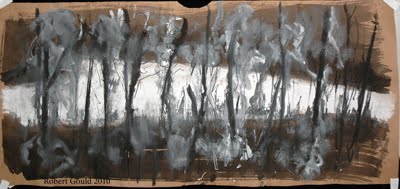
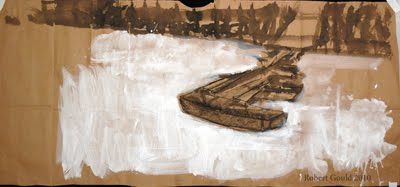
I started my Ebenezer project with this series of drawings. I was inspired after trolling through the Library of Congress Civil War photo collection. (http://www.loc.gov/pictures/collection/cwp/) Their I discovered a number of period photographs from the swamp areas of the deep south. I was struck with the way the vegetation looked & how it photographed. Quite mysterious & menacing. For my first compositions I wanted to show the pontoon bridge in the river as seen looking through the trees. The bridge does not make it all the way across.
Later after reading about what an Ebenezer was I added the symbolism of the rock. I use Trader Joe's paper shopping bags. I am trying out different views & compositions. The materials are compressed charcoal, white conte crayon, sumi ink, & white house paint. I have to work quickly on this paper once it's wet. It won't take much abuse. The time limit is also good for me so that I try to get ideas out fast & move on. I jump to the next page when I get a new idea.


Wednesday, August 11, 2010

Ebenezer Stone


“Ebenezer” is a name of Hebrew origin meaning "Stone of the help" (derived from the phrase "Eben ha-Ezer") For my Tragedy of Ebenezer Creek work I constructed a Ebenezer stone out of plaster. I created a wooden mold & cast the plaster into a long rock shape. The color treatment is graphite.
Back of Ebenezer Stone
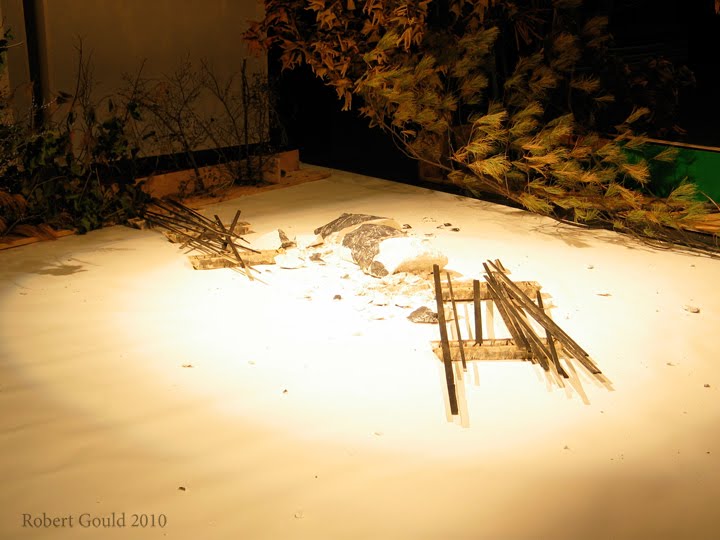
Broken Ebenezer Stone on Pontoon Bridge
Broken Promise, Broken Ebenezer

The Tragedy of Ebenezer Creek


This is another photo shoot project. This scene has evolved out of my research into an event that occurred during Sherman’s march through Georgia during the Civil War.

I am including the Wikipedia version of the events.

“Ebenezer Creek is a location in Georgia where hundreds of freed black slaves were abandoned during General Sherman's march during the American Civil War. After the army had crossed over on pontoons the commander in charge of the crossing, BG Jefferson C. Davis, cut them loose, leaving the escaped slaves on the other side. Many drowned while trying to cross over.

The Tragedy of Ebenezer Creek happened on December 9, 1864. General Sherman was already towards the end of his March to the Sea, and was only twenty miles from his final destination of Savannah, Georgia. Slaves followed Sherman's army throughout his march from Atlanta despite the fact that Sherman's army could not support a large following. One of the reasons for this following was the exchange of food for slaves for their servitude with the Union Army, which included cooking and manual labor. Due to the increasing scarcity of food, Sherman urged the freed men to stay behind. Many freed slaves turned around. However, on this particular day, an estimated 670 freed men, women and children were on the march with Sherman's army and were stranded.

Jefferson C. Davis of XIV Corps made the decision to abandon the following. Davis' units crossed the pontoons first, leaving the freed men on the other side. Then the order was given, and Davis' last regiment, the 58th Indiana, blocked the former slaves from getting on the pontoon. Davis tricked the former slaves into thinking that their being held back at first was for their own safety, making them think that they would be safe in the back in case a fight should happen in front. It was under these pretenses that the line was cut and the pontoon made it to the other side of the icy water about thirty to forty yards away.

It was at this moment that cavalrymen of Major General Joseph Wheeler of the Confederates came to the side of the creek where the slaves had been abandoned. Many dived into the river trying to swim across and drowned, while others were shot in a brief attack. Davis' men left as soon as Major General Wheeler's men were in sight. After the initial attack, Confederate cavalrymen left to find another way around the river; they later came back to capture those who were left behind.

Many blamed the incident on Davis, but General Sherman stated in his memoirs that Davis was just being a soldier. But at the same time General Sherman and other soldiers admitted Davis' hostility and his apparent racism to the former slaves. The Tragedy at Ebenezer Creek would remain synonymous with Davis' actions.”

http://en.wikipedia.org/wiki/Ebenezer_Creek


General Washington's Retreat from Brooklyn New York 1776


I have been playing around with constructing situations that relate to events from history. Using a theater space & lighting I am able to build large-scale set-ups for photo shoots. These photo shoots enable me to better visualize & compose various scenes. My idea is to use the photographs as a starting point for larger paintings. The painting will use the photograph as a ground over witch I will paint.
The first set-up deals with General Washington’ Continental army’s retreat across the East River from Brooklyn to Manhattan. For this basic set up I constructed 13 paper boats that were based on the type of boats that were used &active in New York harbor in 1776. I next arranged them on a background & photographed them. The next phase of this project will involve recreating this set up close to the actual place were the events took place in 1776.

Here are the first sketches for this project. The medium that I'm working with lend them self well to idea of small boats disappearing into fog at night.