Monday, August 1, 2011

Night Time Cannon Firing at Antietam


I am lucky that the stars were aligned and I was able to witness the following event. I just happened to be in Maryland visiting my family when I checked my computer and read a blog post by Mannie Gentile, (See his blog here) He wrote "Come to Antietam tonight and see a night time cannon shoot!" Three hours later, I found myself on the field of Antietam next to the New York monument  and two replica 12 pound Napoleon Cannons. They were set up over looking the cornfield area of the battlefield. It was a low-key affair attended by about 50 others. The weather was unsettled, with a thunderstorm passing to our north. We had a couple of sprinkles from it, so I ducked into the nearest shelter. There I found myself setting in a pew of the Dunker Church with a bunch of guys dressed in Confederate “butternut.” Quite surreal.
Dunker Church Antietam. Shot with Holga Wide angle Pinhole on Fuji 100 B&W. It was about a 15 second exposure. The film got fogged when I changed rolls.
For my photographs I used my Holga 120N and Fuji 100 ASA B&W film. My goal was to capture the muzzle flash and smoke of the cannon discharge. Luckily the sun was setting and it was a cloudy twilight. I took a chance and set my Holga to bulb and set up my tripod. My vantage point was about 25 feet away from the left gun. I just guessed at the exposures. When I saw the crew set the friction fuse, step away, and yelled “Ready!” I opened the shudder.
"Servicing the gun". With South Mountain as a back drop I set up my tripod at the corner of the New York Monument. I have arranged the photos in chronological order. Both guns were fired three times.  Note how the images become more dramatic as it gets darker.
Notice that the number three gunner, behind the cannon, is still because he is "thumbing the vent". In other words he has his thumb over the vent hole in back of the cannon. This is an important safety measure because it keeps air from entering the gun and douses any left over embers that could explode the next gun powder charge.
First shot.
I like this shot. Reloading for shot two.
Second shot. Note the vertical spouts of flame erupting from the vent hole in back of the gun.
Fire three! Both guns discharged almost simultaneously.

 Mannie Gentile blog-

Friday, July 22, 2011

HMS Indefatigable- The "Splash" project

I am revisiting a body of work that I started in 2009. This work is inspired by a photograph of the sinking of a English war ship HMS Indefatigable during the Battle of Jutland May 31,1916. 

The HMS Indefatigable sinking after being struck by shells from the German ship Von der Tann. Only three sailors out of 1,017 survived. Here is the link to the Wikipedia page. http://en.wikipedia.org/wiki/HMS_Indefatigable_%281909%29
It’s a dramatic image of the ship sinking shrouded in smoke and clouds on the horizon. This intense action is taking place so far away that it obscures the gravity of the struggle. In a closer examination of the photo I noted an area of white water in the foreground. It looks to me as if something has hit the water and created a splash, moments before the photo was taken. I began to imagine that some other unseen ship was firing at the ship that the photographer was on. The area of white water was evidence of a near miss. The shell harmlessly exploding in the water next to the ship sailing by. 

  My reinterpretation of the photograph started with some drawing with ink and white gouache. 

Ink and Gouache on white paper. Copyright Robert Gould 2009

Ink and Gouache on white paper. Copyright Robert Gould 2009

Ink and Gouache on white paper. Copyright Robert Gould 2009
 These drawing lead me to examining the relationship between the sky and water. First, tonally with ink, & then with color using oil sticks on paper. I like the composition, however ultimately color is going to be an important element of this work. The sea and sky merging together has be just right. 
Unfortunately the photos of the paintings below are washed out. I am going to have to re-shoot them at some point. 
Oil stick on brown paper shopping bag.

Oil stick on brown paper shopping bag.

Oil stick on brown paper shopping bag.

Oil stick on brown paper shopping bag.
Adding the tricky element of color reminded me of the painting “Nebraska” by Brice Marden.
“Nebraska” by Brice Marden 1966.
The color must be perfectly balanced as in the Marden work. It would be nice to observe the true color in nature before I can continue with the project.

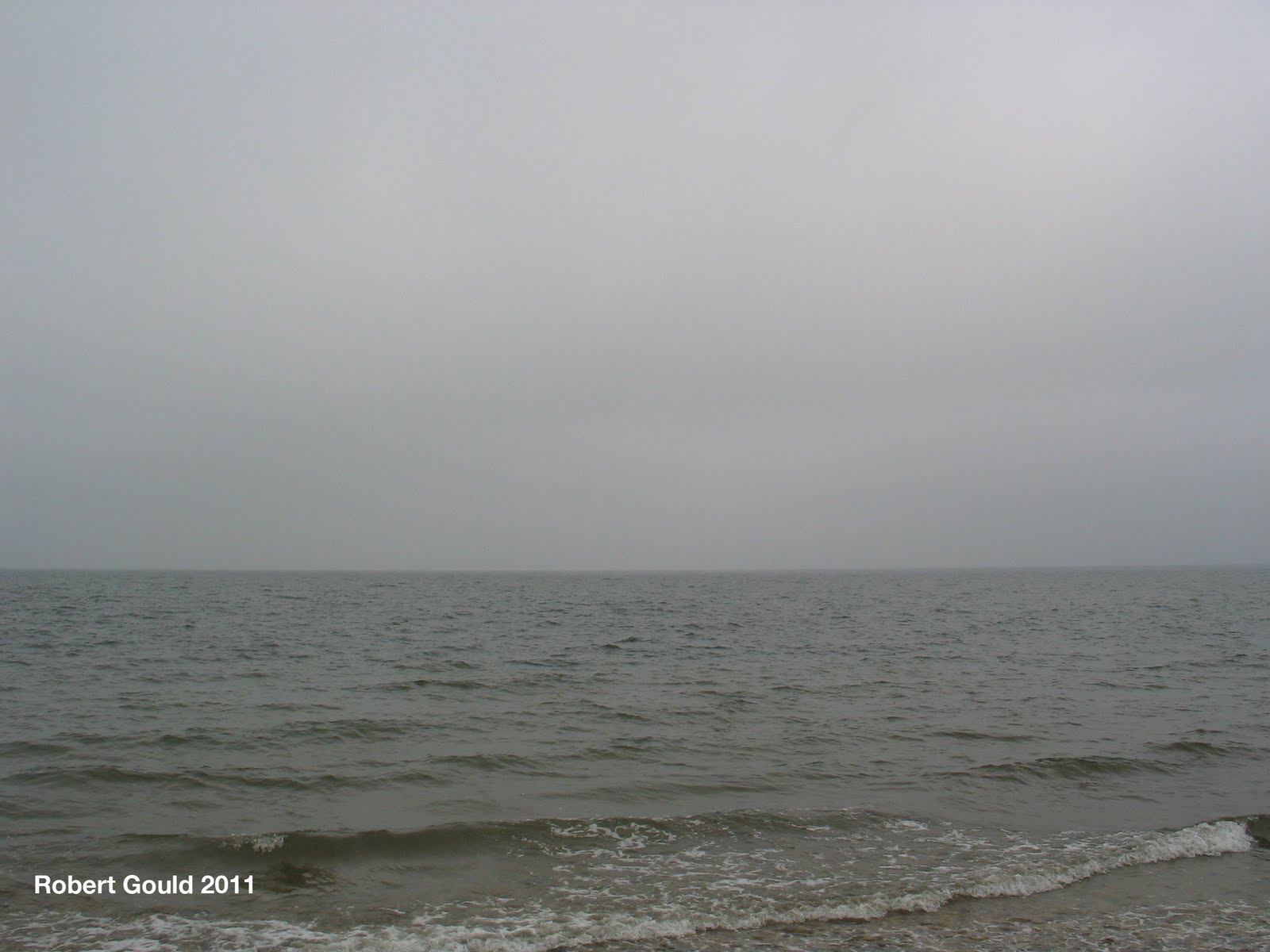
This summer our vacation cottage over looked the Long Island sound. Seeing the ocean view reminded me of my splash project and the location enabled me to observer the sea and sky for an extended period. I had the luxury of just grabbing the camera a taking a few pictures every time the light conditions were right. The result was a collection of photos and a starting point for some more oil color studies.


Monday, July 18, 2011

Orient Point Civil War Mounment


Image number 1. This is the earlier of the two postcards from the early 1900's. Notice the streets are unpaved. I wonder if any of the trees are the same in both photographs?

My family and I spent our holiday on the North Fork of Long Island this summer. Often we would drive from Jamesport area out east to the towns of Greenport and Orient. We liked to eat at a seafood place that was also a boat marina near Orient Point. One day walking into the restaurant, I noticed a display of old 19th & 20th century post cards showing the area around Orient. The ones that caught my eye were two depicting the Civil War monument in Orient. I thought that it would make a good now and then photo project. So the next time I we came out to the restaurant I brought my digital camera and capture the postcards & the actual scene. The monument was dedicated in 1870, and I believe that it honors the area men that fought in the war of rebellion. There are a number of names inscribed on the four sides. Greenport and South Hold have similar monuments. More on those later.


Image number 2. A later postcard possibly from the 1920's. Notice how the street's have been paved and a sidewalk put in. The Orient Congregational Church is hidden behind the trees in the modern view.


Friday, July 1, 2011

#mapBK mysteries

[Untitled], ca. 1888.[Untitled], ca. 1888.[Untitled], ca. 1888.[Untitled], ca. 1888.Beach at Coney Island, Brooklyn, ca. 1888.[Untitled], ca. 1888.
Children and Dolls, Brooklyn 1880's, ca. 1888.[Untitled], ca. 1888.[Untitled], ca. 1888.[Untitled], ca. 1888.Blizzard of March 1888, Brooklyn, ca. 1888.Family, Brooklyn, ca. 1888.
[Untitled], ca. 1888.Boat, Water, ca. 1888.Coney Island, 1897.Untitled, 1896.Surf Avenue, Coney Island, 1902.Coney Island Fire, Coney Island, 1903.
Surf Avenue, Coney Island, 1902.Snow Scene, Prospect Park, Brooklyn, ca. 1872-1887.Up the Trout Brook, New Lots, Brooklyn, November 26, 1874.Down the Meadow Lane, New Lots, Brooklyn, November 26, 1874.Owls Head, Bay Ridge, Brooklyn, ca. 1872-1887.View at Hunt's Dock, Bay Ridge, Brooklyn, ca. 1872-1887.

#mapBK mysteries, a set by Brooklyn Museum on Flickr.

Found some new online photo sites. When I get back from vacation I will be posting to Historypin's.