Thursday, June 26, 2025

Convoy PQ17 ( Azerbaijan)

Convoy PQ 17 was one of the Arctic convoys, a series of vital supply routes during World War II that delivered essential war materials to the Soviet Union via northern Russian ports. The route to Murmansk and Archangel was particularly hazardous due to German naval and air forces, as well as the harsh Arctic weather and ice conditions. Convoy PQ 17 suffered heavy losses, with only 11 out of 35 merchant ships reaching their destination. 
The Soviet tanker Azerbaijan was part of Convoy PQ 17, which sailed from Iceland to Murmansk and Archangel in the Soviet Union during World War II. The convoy, which aimed to deliver supplies to the Soviet Union, faced heavy attacks from German U-boats and aircraft, resulting in significant losses. The tanker Azerbaijan, despite being damaged by a torpedo, managed to make it to port with the help of its crew, including the mainly female crew who fought to save the ship. The actions of the crew, particularly the female members, in saving the tanker were considered heroic in the face of adversity. 
I created these small paintings on some scrap wood that had random paint applied. Normally cut off scraps like this end up in the bin. However- I found the random paint color and splashes compelling and evocative in some way. So I held on to these for a couple of years waiting for this project to come along.
5"x7"
4"x8"
4.5"x4.5"

Nude Landscapes

 Playing around with a prompt from my daughter. 

I originally envisioned these nude laser transfer image paintings as stand alone images. I feel that they still can. I just need to come up with a framing method. Currently they are on thin wood panels.

But taking her suggestion I assembled them into one composition. I have enough of them to create three separate larger works. I made a rudimentary attempt to arrange a flow and pattern with them.


34"x33"

44"x34"

34"x33"


Wednesday, May 14, 2025

Hall of Gowanus Exhibit


Last month I was in a group show Hall of Gowanus.I was asked to show some older work. It was fun to see the work and to reunite with local artists.  I want to thank Sasha Chavchavadze for inviting me. There have been so many rapid changes to the Gowanus neighborhood in the last 5 years. Below are some pictures from the exhibition.


Maryland Willow of the Gowanus. See older blog posts for detailed information about this work.


Three pinhole camera photos of some Brooklyn historical sites.


Friday, June 28, 2024

Dog Woods


This series evolved out of my work with expired house paint. I had made a number of panels using expired house paint. See a previous post about that process. I had always thought of some of them as a painted background, meaning I would paint something else on top of the image that I was achieving with the house paint. I felt that even though some of them were turning out quite beautiful on their own, that I perhaps needed another pictorial element.

As spring rolled around, the dog woods started to bloom. They are such a large and simple and numerous flower. Their delicate white color stands in contrast to the fresh green of the tree's leaves. I thought that these flowers might make a good pattern to add against the vertical background of my expired paint experiments.


My process was to pick some of the flowering dogwood blossoms and photograph them. After adjusting the contrast in photoshop and sizing them. I printed them with the laser printer.The paint is applied using the cut out paper as a stencil. After the painted shape of the blossom dried I added the delicate lines of the laser print photograph on as a top layer.


Figurative Landscapes


This series came about because a student assistant had mixed up too much of this flesh toned color. They kept adding more and more paint together in an effort to get a different color. In the end the student abandoned the attempt and left a half gallon of this color setting on the mixing table unused. Me, being the studio manager, not wanting to discard the large amount of paint, set it aside hoping another project might come along where that paint might be useful.


Thinking that the color reminded me of flesh, I wondered if I could use it that way. First I tried to use it as a flesh tone and experimented with painting a figure. However the paint did not mix well with other paints. And I just wasn't finding anything with that approach that ultimately interested me. Working with some photographs I had taken that had been enlarged. I became interested in the abstract forms that the human body and skin can make. While not necessarily identifying any particular area of the body. The resulting images became abstracted landscapes of sorts in my mind. The flesh tone of the paint reinforces the essence and further references the human form.


I used laser print transfer to add a photographic line element. I also set the flesh tone against a dark background. Letting the two colors blend and merge with the print. The effect reminds me of an early wet plate photographic process.


All the paintings are 8.5 x11 inches. On a wood panel. 2024.


Monday, May 6, 2024

House Paint Series

 In the previous post I discussed my painting process I use to create these paintings. This post featured the paintings themselves.


House Paint Series process

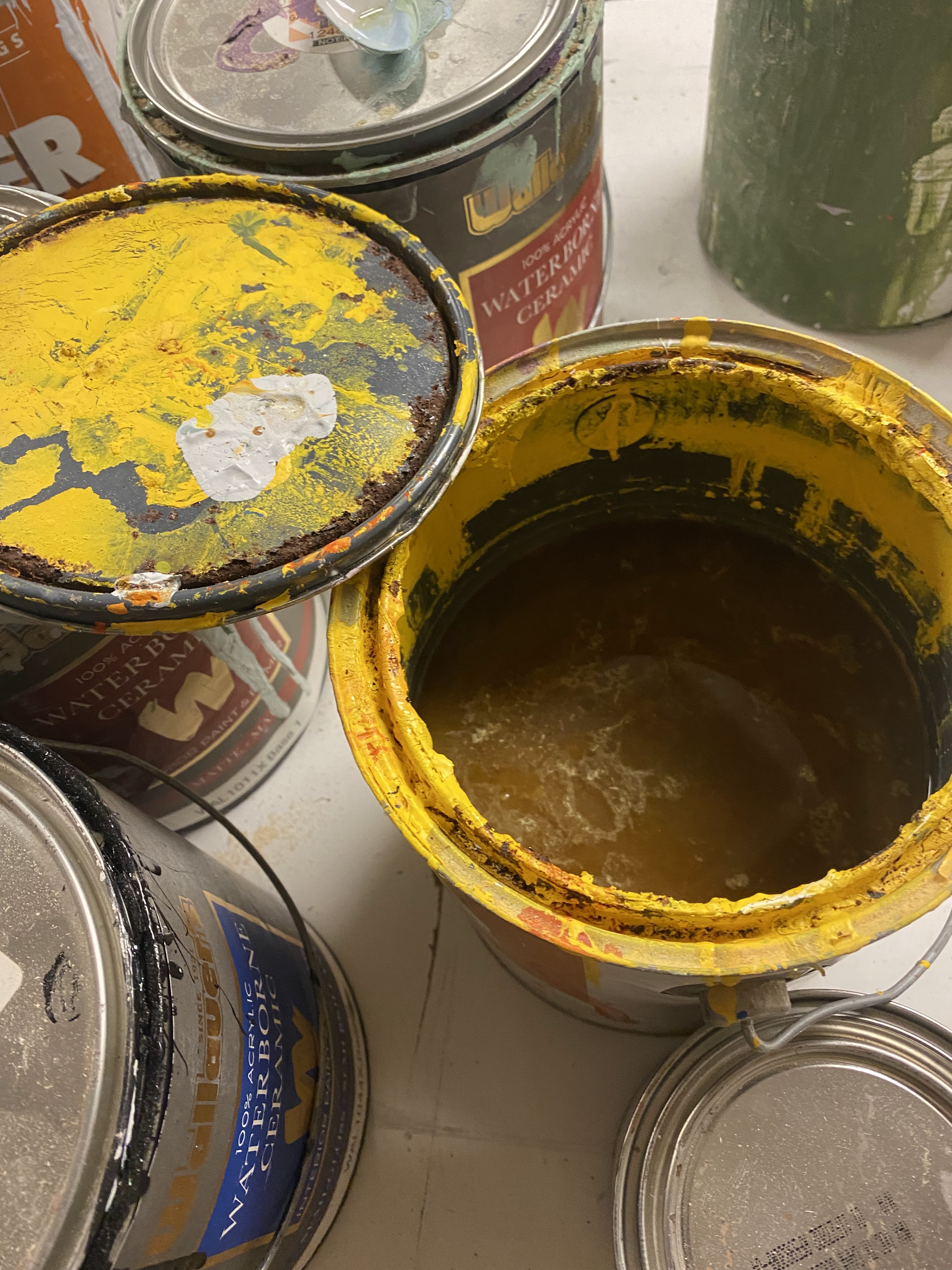
Every year I go through the paint closet and weed out old cans of paint that can’t be used or salvaged. I use a lot of house paint to paint theater sets so it is necessary to periodically go through the shelves checking the paint cans for expired paint. As the opened cans of paint age, they can dry out, separate, or even develop mold. If the paint is still liquid but unusable the can is filled with sawdust to fully dry it out before being tossed. I began to feel that perhaps I could find a better use for this stuff.  .

The collection of random cans of paint colors 

My palet has been limited by what paint is expired and saved from the trash.

Moldy separated yellow paint. 

Occurring parallel in the theater scene shop we use thin plywood called  luan. Working with his material  also produces a fair amount of waste and off cuts. I brought together these two waste products and repurposed them into artwork.

A number of wet panels drying on the studio floor

My process became trimming the luan plywood into uniform dimensional panels. Then spooning paint across the top edge and using a wide pallet knife like a squeegee pull the paint across the panel. Often I spoon on a couple of colors and let them combine and mix in a random way as they are squeezed across the surface. Each successive scrape of the knife further blends the layer of wet paint together and simultaneously reveals lower layers of dried paint underneath. 


The painting is set aside to dry where after another layer of paint in a complementary color is added in a similar possess. I repeat this process over and over. Adding paint then scraping it way.


The choice of working with the medium of discarded house paint is a direct reference to my Father’s scientific work. He worked for the Food and Drug administration where he invented and patented a quick and easy chemical process to determine the presence of dangerous levels of lead in house paint. His lead detection kits are still widely used because they are so simple and accurate. My process of layering paint alludes to the countless times interior walls are repainted in Brooklyn apartments. Often dangerous lead paint remains on walls hiding under many layers of paint that have been applied in the years since lead house paint was banned.