Thursday, September 13, 2012

Go Brooklyn Open Studio event


Last weekend (September 8/9) I participated in Go Brooklyn. The event was sponsored by the Brooklyn Museum of Art. The concept was to have the artists of Brooklyn open there studios to the public for one weekend. The public was then encouraged to vote for an artist that they saw and liked. The votes would be tallied and 10 artists would be included in a group show at the Brooklyn Museum.
The GO project was very well run and publicized. In all I had about 50 visitors over the two days. The weather being much better on Sunday than Saturday effected the turn out.Overall  I got a pretty positive response from most people.Interestingly enough, a number of the visitors were other artists that were not participating in GO. Each one was horrified when I revealed that the paper I work on is from paper shopping bags. “But it’s not archival” they all said. I also got the comment "I wish my husband was here, he would enjoy this”.
Below are some random shots of my studio set up. I decided to present mostly "Battle of Brooklyn" themed work. After all, the 136 anniversary of the battle was just two weeks prior. For the studio, I took over our front room and hung work up and set out paint supplies on tables. Most of the time, I work in another room in our loft. But for this I didn't want people going through our living area.I could also hang everything together for a gallery like feel.
Here is my portable work table/ easel/ old door. Most work starts out here, flat on this table an then moved to the wall for finishing.


Two paintings from the Exodus from Brooklyn.

The two panorma paintings of Brooklyn in 1776. On the floor is a red milk create (center), it contains my soil collection that I use for creating paint.

In the bottom right corner you can see "the stack of generals". I have 20 paintings of Union Generals that were at Gettysburg. Some day I will create a blog post about them.
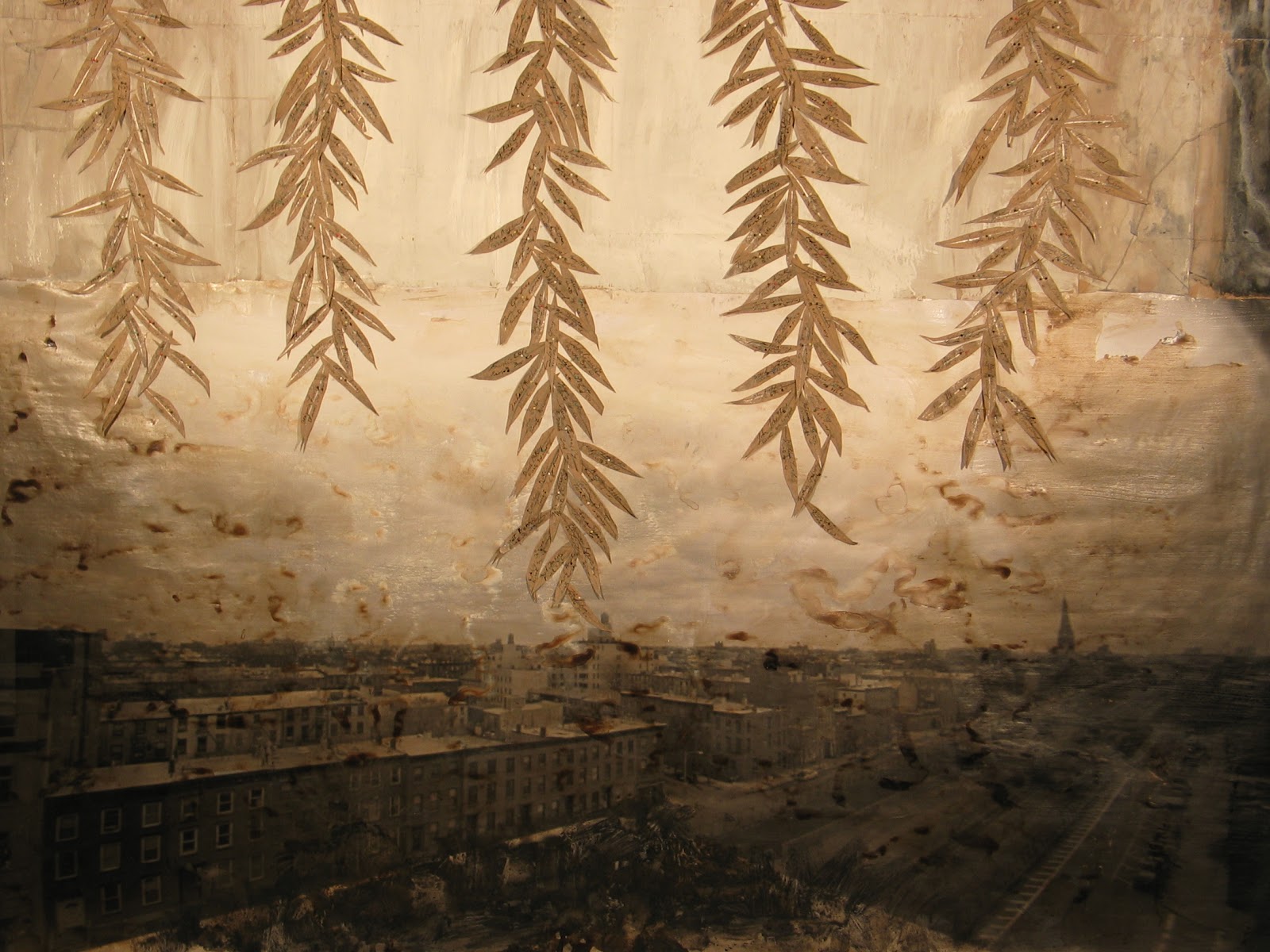
I showed a new work that I am working on about the Maryland regiment that fought at the Old Stone House. I use images of willow leaves that I write out the names of the soldiers on. The leaves are formed into willow bows, that in turn mark out the different companies that the soldiers fought with. The background is an enlarged pinhole image I took of the Brooklyn skyline facing the area of the battlefield.


Tuesday, July 10, 2012

Divine Intervention- Washingtons Retreat from the Battle of Long Island

On the night of August 29/30, 1776, General Washington evacuated his entire army from Long Island right under the nose of the English army. Moving it one mile across the treacherous East River, at night, in thick fog, by small boats, to New York city. The whole endeavor was aided by an unusual confluence of weather events. I believe that Brooklyn must have experienced a nor'easter or perhaps a weakened hurricane during this time. Winds from the north kept the English fleet from sailing into the upper New York harbor and severe rain storms ended the fighting on Long Island on the 27/28th. Perhaps a good example of the kind of storm that was experienced in 1776 was the type Brooklyn residences experienced last summer with hurricane Irene. 
These paintings are titled "Exodus" after Moses flight from Egypt. I was inspired by an account from Henry Whittmore's 1897 book "Heroes of the American Revolution and their Descendants" 

" Surely that fog was the shield of God's providence over those men engaged in a holy cause. If the stars in their courses fought against Sisera, in the time of Deborah, the prophetess, these mists were the wings of the cherubim of mercy and hope over the Americans on that occasion." page 34


'Exodus' June/July 2012 Mixed media on paper shopping bags, 67"W X 32"H
Detail of paper boats right side

Detail of Left side
"Exodus 2"June/July 2012 Mixed media on paper shopping bags, 67"W X 32"H
Exodus 2 detail

Exodus 2 center detail
"Exodus 3"June/July 2012 Mixed media on paper shopping bags, 67"W X 32"H
Exodus 3 side view detail

Exodus center detail

Below is further historical account of the evacuation.

"dispositions were made for an immediate retreat. This commenced soon after it was dark from two points, the upper and lower ferries, on East river. General M‘Dougal, regulated the embarkation at one, and colonel Knox at the other.  The intention of evacuating the island, had been so prudently concealed from the Americans, that they knew not whither they were going, but supposed to attack the enemy. The field artillery, tents, baggage, and about 9000 men were conveyed to the city of New-York over East River, more than a mile wide, in less than 13 hours, and without the knowledge of the British, though not six hundred yards distant. Providence, in a remarkable manner favored the retreating army. For some time after the Americans began to cross the state of the tide, and a strong north-east wind made it impossible for them to make use of their sail boats, and their whole number of row boats was insufficient for completing the business, in the course of the night. But about eleven o’clock, the wind died away, and soon after sprung up at south-east, and blew fresh, which rendered the sail boats of use, and at the same time made the passage from the island to the city, direct, easy and expeditious. Towards morning an extreme thick fog came up, which hovered over Long-Island, and by concealing the Americans, enabled them to complete their retreat without interruption, though the day had begun to dawn some time before it was finished. By a mistake in the transmission of orders, the American lines were evacuated for about three quarters of an hour, before the last embarkation took place, but the British though so near, that their working parties could be distinctly heard, being enveloped in the fog knew nothing of the matter. The lines were repossessed and held till six o’clock in the morning, when every thing except some heavy cannon was removed. General Mifflin, who commanded the rear guard left the lines, and under the cover of the fog got off safe. In about half an hour the fog cleared away, and the British entered the works which had been just relinquished. Had the wind not shifted, the half of the American army could not have crossed, and even as it was, if the fog had not concealed their rear, it must have been discovered, and could hardly have escaped."
Attributed to  David Ramsay’s The History of the American Revolution Vol 1 1811
From the wed site http://virtualology.com/revolutionarywarhall/BATTLEOFLONGISLAND.COM/

and from Google books https://play.google.com/store/books/details?id=fiQTAAAAYAAJ&rdid=book-fiQTAAAAYAAJ&rdot=1


Sunday, June 24, 2012

Light and Sound Paintings

Detail of large painting on paper. June 15, 2012
I thought it would be fun to re-examine a series of drawings I created in the early 1990's. During the late 1980' and early 1990's I built sound sculptures and machines. They were constructed out of everyday items, trash and electric motors. It wasn't high tech, it was more DIY. Build with odd bits, my work had a "Rube Goldberg" aesthetic. At that time, computers were not as ubiquitous as they are today, so I "played" them using simple on/off switches. At that time, my goal was to construct machines that made "visual" the sound creation process. In other words, the design and construction always spotlighted the elements that were creating the sound.
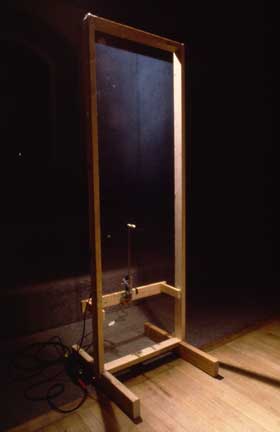
One of the drum machines at St. Marks Church 1989. You can see the clear Mylar catching the light.

Another Drum machine showing the relationship of the light and the shadow projection 1992. I used a sheet of set paper to project on. The shadow is the dark round form in the center of the lighted rectangle. The round shape is the hammer contacting the Mylar surface.

One device that was successful in depicting the physical creation of sound was a type of drum machine that I created with Simon Samman. It was a simple frame covered with thin Mylar. When a contact mic was attached to the Mylar, and the Mylar struck, it created a low bass drum sound. Like a lose kick drum. I then automated the drum by attaching solenoid driven piano hammers that would tap on the Mylar. This worked out pretty well except I didn't have anyway to create drum patterns or anything, so the drum beats were one dimensional. Boom, boom, boom.
It wasn't until we preformed a concert at St. Mark's Church that I saw the further visual potential of these machines. During rehearsal, I noticed that when theater lights were focused on the sculptures, and when the hammers hit the Mylar, it created rippling light reflections in the shadow cast by the device. The light was reflected off the vibrating surface of the Mylar as it was struck. It looked like a fast moving water wave effect, similar to the surface of a swimming pool, reflecting a pattern of small waves. It was the clearest visual manifestation of sound and sound waves that I have created.

Drawing number 1 I started this series working on 17" X 38" paper shopping bag paper
Drawing number 5. 17" X 38" paper shopping bag paper
Drawing number 3. 17" X 38" paper shopping bag paper
Drawing number 2. 17" X 38" paper shopping bag paper
Drawing number 4.17" X 38" paper shopping bag paper

This summer I thought back to creating painted works that are a visual extension of this earlier work. I also thought it would be a nice warm up exercise to start the summer creative session. Creating these drawings are fast and physical. I paint them with the paper lying on the floor with a brush attached to a long stick. This time I wanted to work with creating a light colored line on a dark background. Just like how I observed my sculptures working. I started with a ground of black tempra paint. After it had dried I drew a gestural line drawing on top with white house paint. Just before that dried I worked back into the surface with a wet brush. Partially erasing the white lines. I worked back and forth adding white lines and taking them away, building up a random pattern that I could edit.
I felt that the 17"x38" size paper was to little small for creating a physical gesture from the brush strokes. So I finished this series with three drawings on larger paper made from gluing three shopping bags together. This is a photograph of the painting in progress. The finished painting is below.

Drawing number 1 35" W X 45"H Finished state.

Drawing number 2 32"W x 51"H

Drawing number 3 32"W X 51"H Maybe I should look into creating another drum machine?

Wednesday, May 23, 2012

Punkiesburg- Cobble Hill- And the Battle of Long Island

-->
From this lofty perch the eye of the commander (General George Washington) swept the field, and gathered up its various tokens of disaster. "Good God!" he cryed; "what brave fellows I must lose this day"! as he saw the young Marylanders fling themselves again and again upon the enemy." 
“Within the lines of the entrenchments”, says Field “two other fortifications had been constructed to command important points. One of these was erected upon a conical hill called Ponkiesberg. Which rose in such prominent and well defined outline from nearby plane surface, as to excite the query if it was not the work of human hands. It occupied the western half of the block bounded by Atlantic, Pacific, Court and Clinton Streets, and it’s elevation above the present grade was from sixty to eighty feet.” “The work mounted four guns, and from it’s central interior position could have prevented the enemy from securing a foothold on the peninsular in the rear or flank of the main line in case they effected a landing back of Red Hook or crossed the Gowanus Creek above”
The above quotes were taken from "The Heroes of the American Revolution and their Descendants, Battle of Long Island" by Henry Whittemore 1897
This post is part of a continuing series examining areas of Brooklyn that were involved in the Battle of Long Island. My goal is to create art work that is some how related to these long ago events. I am not simply illustrating these event but am looking for a more universal, personal documentation of the events and landscape. The Punkiesburg location is one of the more interesting points on the battlefield. It was such an unusual land feature, and has been so utterly erased, that viewing this location today; it's hard to imagine a round hill sixty or seventy feet high. It is precisely this idea that lead me to create some art works that attempt to re imagine this location. The post below out lines some of my "armchair Internet research" about the area and it's history. Future posts will feature the art work that I have created.
Detail from a map that was posted on the Brooklyn Historical society blog. I found this visual depiction of the hill in the center of the map quite compelling. The hill stood out as a unique feature in the landscape. It looks like a tall round mound with tress all around it. It is curious to note that Mr. Bergan has spelled it "Punkins Barach". Not sure where this spelling comes from. The map is said to be a copied from a much older map. For more information about this map, the original blog post is Here-http://brooklynhistory.org/blog/2012/02/06/map-of-the-month-february-2012/
The image above is from 1922 and shows the intersection of Atlantic Ave and Court Street. As you can see the hill has been  leveled, and is long gone. I have read that this was done by the occupying British army in the 1780's.But below there is a reference to a later fort from 1812 era. I have found it hard to construct a firm time line for events from this period. This photo is interesting because it shows the structures that were there before the present Brooklyn Savings Bank building. Today the building is occupied by a Trader Joe's.The buildings in the photo look like they date back a good 75 years, dating the structures to the 1840's. It was around this time that the street grid was formally laid out.The image was taken from the New York Public Library web site found here
Today A kiosk marks the spot in front of Trader Joe's. Nighttime photo from iPhone.
My first approach was to document the area with photography. Because the location is only a 5min walk from my studio I made several trips over time and shot with a number of cameras.    

"Corkscrew fort, a small redoubt upon an eminence near the Brooklyn Athenaeum* of today, commanding Red Hook Lane, and meant for it's defence in case the enemy should cross Gowanus Creek. Tradition says the the redoubt was sixty or seventy feet above the present street grade of Atlantic Avenue at this point."
 My wide angle pinhole image of the intersection of Atlantic Avenue and Court Street, Brooklyn New York. From this prospective you can get a feel as to how high the original hill was. Local folklore has it that the hill was as high as the top of the flag pole. The fort got the name "Corkscrew" because of the way the pathway spiraled up to the top of the mound.
Image taken with my 1920's era Kodak Brownie No2
Close up of the flag pole. Image taken with my 1920's era Kodak Brownie No2

The plaque describing the Battle of Long Island. It shows General George Washington on his horse. He is pointing in the direction of the fighting at the Old Stone House. "Good God!" he cryed; "what brave fellows I must lose this day"! Image taken with my 1920's era Kodak Brownie No2
Perhaps a little to far away.
“During the war of 1812 another fort was erected upon this hill and called Fort Swift, but at the point of the Revolution it was known as Corkscrew Fort and Cobble Hill”
 From "The Heroes of the American Revolution and their Descendants, Battle of Long Island" by Henry Whittemore 1897

My Brownie No2- like new, with original box and a number# 1 close up lens. Thanks E-bay. The number 2s are great because they take regular 120 film. I haven't had time to play with the close up lens. It's a simple lens that snaps in over the lens hole in the camera face.
In a following blog post I will show some art work that I have created. For further information about this area check out this link to the Old Stone House- http://theoldstonehouse.org/battle-of-brooklyn/map/

*=See this article in in brownstoner blog for more information about the Brooklyn Athenaeum. http://www.brownstoner.com/blog/2010/08/walkabout-the-b-3/#athenaeum-1-1

Tuesday, May 22, 2012

Rose Farm Gettysburg


I am going to add this image from 1863 to compare with the above image that I took in March 2012. I am including it so as to inform readers that are perhaps not familiar with this series of photographs.


Back in March I stopped of at Gettysburg.The photos above were shot in the Rose Farm field with a Holga 120 on Fuji Acros. The angles are roughly the same as the famous photos of Confederate dead awaiting burial. Photographed by by Alexander Gardner and crew, July 1863. Although it is quite extraordinary to be at this location and see exactly where this horrific set of photos were taken, I will refrain from republishing all of them here. If you are unfamiliar with them and need to see more. I recommend William Frassanito's book "Gettysburg a Journey in Time"

On a lighter note, I could not resist having my photo taken sitting on Alfred Waud's perch at Devil's Den. His beard was a lot thicker than mine!