|
Wednesday, May 28, 2014
My solo show at Brooklyn Box- Opening June 7
![bkbx [Brooklyn Box]](https://gallery.mailchimp.com/5f1e1e1e5c95a7821e61ae097/images/bkbxLogo210.png)


Thursday, May 8, 2014
I have work in a group show in Jersey City

We hope you'll join us for the opening of
Terra Incognita at Curious Matter–
this collection is positively amazing!
Sunday, May 18, 3 to 6pm, please come!
DRIVING FROM MANHATTAN: Take the Holland Tunnel. Exit the tunnel and turn left onto Jersey Avenue. (Jersey Ave. is just past Rademan Place, SUNOCO is on the right. If you are on I-78 W and reach NJ-139 you’ve gone a little too far.) Follow Jersey Avenue straight ahead then turn right onto 10th Street. Take the first left onto Coles Street. Turn left onto Fifth Street. 272 Fifth is on the left. It’s just a few minutes drive once you’re out of the tunnel.
PATH FROM NYC: Take the Newark/Journal Square bound PATH train from 33rd, 23rd, 14th or 9th Streets (all at 6th Ave.) or from Christopher Street or WTC. Get off at GROVE STREET station. Exit and walk West on Newark Ave. When you reach Jersey Ave. make a right and continue to 5th Street. The gallery is to the left at 272 Fifth Street. TWO TRAVEL NOTES: 1) The PATH train stops in Hoboken before continuing to Jersey City on weekends. 2) The WTC line is currently out of service on weekends.
YOUR SUPPORT Curious Matter is a sponsored project of Fractured Atlas a 501(c)(3) public charity. Contributions for the purposes of Curious Matter are tax-deductible to the extent permitted by law. Just go to curiousmatter.org and click Donate Now.
CURIOUS MATTER is an exhibition venue for contemporary visual art located in downtown Jersey City, NJ. Curious Matter exhibitions and publications evidence the pursuit to understand and articulate our individual and collective experience of the world, real or imagined. We examine fantastic notions, confounding ideas and audacious thoughts. Curious Matter strives to foster dialogue among artists at all career stages with a calendar of regular exhibitions. Our commitment extends to our audience as we endeavor to open a door to appreciating contemporary art in an atmosphere that encourages engagement and curiosity. Curious Matter is a sponsored project of Fractured Atlas, a non-profit arts service organization.
For more info: [w] www.curiousmatter.org; www.facebook.com/curiousmatter
[e] gallery@curiousmatter.org [t] 201-659-5771
[e] gallery@curiousmatter.org [t] 201-659-5771
Monday, May 5, 2014
100 Poppies- Centennial of World War 1 Painting
In honor of the centennial of the start of World War 1, I am building a new painting, entitled "100 Poppies". I am using a simple pictorial sequence of 100 poppies images, representing the span of time in years that separates us, in the present, from the time of World War 1. Poppies are laid out in a linear time line format that starts in 1914 and leads to the present day. The chart starts in the lower left and moves to the right for twenty spaces, or years. It then starts again on the left side one row up. Thus it moves upwards for five rows. Each row can be conceived of as one generation.
The painting is in two parts for ease of handling. The finished painting will be sixteen feet long and four feet high. I am building it for my solo show opening next month at Brooklyn Box. It will take up an entire length of one wall of the gallery. Again it is constructed using paper shopping bags, battlefield earth, and pigments.
 |
| The left hand section. Depicting the cauterized war years. |
 |
| The unfinished right hand section of the painting. |
 |
| Close up of encrusted poppie. |
 |
| Cauterized charcoal poppie. |


 |
| Mud encrusted Poppies wet with walnut stain. This home made walnut stain was created from nuts that were collected from the Harper's Ferry battle field during my visit last summer. |


 |
| Mud spattered poppie. |
 |
| Battlefield earth ,pigments and glue |
 |
| Bag of poppies ready for application and finish painting. |
 |
| Flying Squirrel poppies |
Tuesday, April 15, 2014
New work on the easel
I'm posting some paintings that I am preparing for my one person show in June. It will be at Brooklyn Box gallery 543 Union Street, Brooklyn. More on that later.
With this work I am exploring ideas of time, nature, and human conflict. The time frame for the work is the one hundred year anniversary of the start of World War 1. This work was partly inspired from reading Max Hastings book "Catastrophe 1914 Europe goes to war". In it I found some passing references to plants that solders found themselves fighting amongst at the begining of the war. The simple farm fields of Europe, that those farmers would never get to harvest. I have been thinking about how nature reclaims battlefields after visiting many sites of the American Civil War. Today most century old battlefields resemble pristine park lands. Set aside for our remembrance of those who fought there. In these places it seems that time has returned to a natural rhythm, a rhythm of the seasons, the "growing season". This beutiful natural world is the one that confronts us today as we try to imagine what it must have been like 100 years before.I thought about how to depict the yearly life cycle of common plants that might have significance with the gigantic battles of WW1 and the passage of 100 years.
I came up with simply painting out lines of the various plant forms one on top of the other, one hundred times. Laying one drawing on top of another. Mimicking the yearly growing cycle, year by year, decade by decade. Until I reached the one century mark.
With this work I am exploring ideas of time, nature, and human conflict. The time frame for the work is the one hundred year anniversary of the start of World War 1. This work was partly inspired from reading Max Hastings book "Catastrophe 1914 Europe goes to war". In it I found some passing references to plants that solders found themselves fighting amongst at the begining of the war. The simple farm fields of Europe, that those farmers would never get to harvest. I have been thinking about how nature reclaims battlefields after visiting many sites of the American Civil War. Today most century old battlefields resemble pristine park lands. Set aside for our remembrance of those who fought there. In these places it seems that time has returned to a natural rhythm, a rhythm of the seasons, the "growing season". This beutiful natural world is the one that confronts us today as we try to imagine what it must have been like 100 years before.I thought about how to depict the yearly life cycle of common plants that might have significance with the gigantic battles of WW1 and the passage of 100 years.
I came up with simply painting out lines of the various plant forms one on top of the other, one hundred times. Laying one drawing on top of another. Mimicking the yearly growing cycle, year by year, decade by decade. Until I reached the one century mark.
 |
| Sugar beat painted one hundred times |
 |
| Poppies painted one hundred times on grey |
 |
| Poppies painted one hundred times on dark grey |
 |
| Map of Europe with balanced stacks of chairs. I am planning to rework this painting a lot. I don't think that I need the map element any more. I am going to link the stacks of chairs together with string. |
Friday, January 31, 2014
Gettysburg and a Robert Graves Poem
Recalling War
Robert GravesWhat, then, was war? No mere discord of flags
But an infection of the common sky
That sagged ominously upon the earth Even when the season was the airiest May.
Down pressed the sky, and we, oppressed, thrust out.

Boastful tongue, clenched fist and valiant yard.
Natural infirmaries were out of mode,
For Death was young again: patron alone
Of healthy dying, premature fate-spasm.""
The image above was taken last May 2013 over looking the fields from the Eternal Flame Peace Monument at Gettysburg.I am reading up on my World War One literature in preparation for new art for the 100 year anniversary of the start of WW1. This image I took with my iphone jumped out at me after reading this part of the poem. I would like to find a way to link the two together in not such a literal way.
Friday, January 24, 2014
New Work in Progress
 |
| Mixed media works that are based on Eliza's escape across the ice in Uncle Tom's Cabin. |
A brief post about some projects that are on going in the studio. This work is from last May 2013 and this past January 2014.
 |
| Clay and grass objects for a photographic idea |
 |
| Large shopping bag paintings that are unfinished |
 |
| Some ink drawings in prep for some oil paintings. 2014. I am continuing to work on ideas of time passage. This work involves painting and repainting plant forms 100 times. |
 |
| Lupins |
 |
| Sugar Beats |


Views of the Battle of Fort Washington
My commute to work takes through the Bronx. The highway follows the Bronx
side of the Harlem River at one point. From here you get a wonderful view of
the tip of northern Manhattan Island. This area was the location of the Battle
of Fort Washington on November 16, 1776.Today, the neighborhood with the fort is
known as Washington Heights. Coincidentally, It is also the highest land point on Manhattan
Island. Checking out the Wikipedia
page for the battle, I saw this great illustration (see below) from the New
York Library collection.
I was thinking about this picture as I was driving home, and looking past the modern buildings and transit artery’s, I could still glimpse the ancient terrain features. The quality of the print is such that I thought that maybe I could find the location or angle that it was drawn from. This has been done with many early photographs from the civil war with remarkable results.
Driving down the highway I try and see if I can match up the angle of view that is similar to the print. Then I look off to my left to see what terrain feature I could use to photograph from. I identified a wooded area under the University. It has a road I could park and offers a high vantage point where I could look out over the highway.
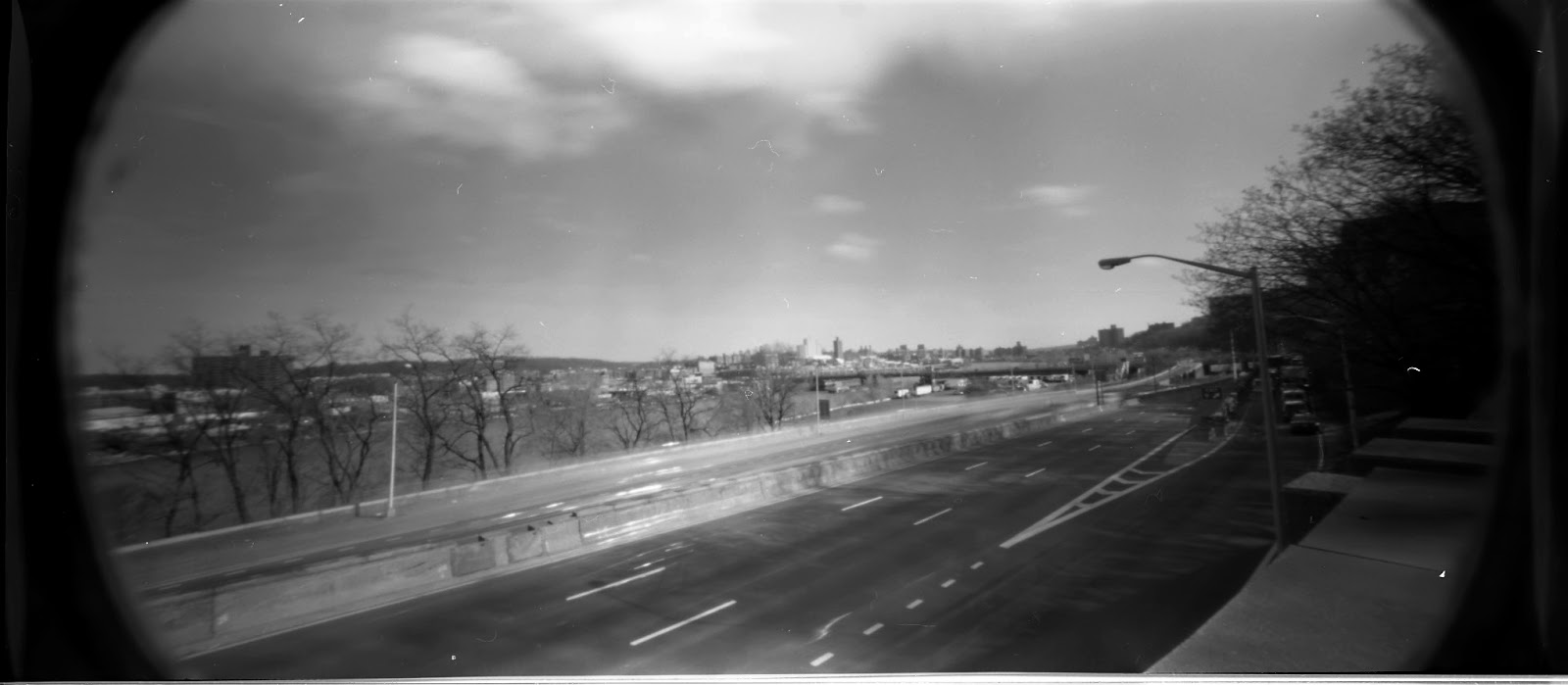


Last March the week before the leaves appeared I was able to make some photographs of the area. I wasn’t happy with the results, partly due to the area is not that photogenic as it exists today and I also had some camera, exposure issues. I also realized that I was not in the right place the original drawing was made.
I constructed a Google map to get a better visualization of the area. Check it out. I guess before the leaves pop out and obstruct the view again I will try and get a photograph from this new vantage point.
View Battle of Fort Washington Painting in a larger map
 |
|
Battle of Fort Washington. View from the Bronx looking
south. The Harlem River is visible with boat loads of English soldiers on their
way to land on Manhattan Island. Puffs of white smoke from the battle are seen
where troops are fighting. On the right side of the picture you can see the
rock cliffs of the Palisades along the Hudson River in New Jersey. The fort itself would be just out of
view in the center. However, I can’t tell if that is smoke or a dip of the ridge line in
that location.
|
I was thinking about this picture as I was driving home, and looking past the modern buildings and transit artery’s, I could still glimpse the ancient terrain features. The quality of the print is such that I thought that maybe I could find the location or angle that it was drawn from. This has been done with many early photographs from the civil war with remarkable results.
Driving down the highway I try and see if I can match up the angle of view that is similar to the print. Then I look off to my left to see what terrain feature I could use to photograph from. I identified a wooded area under the University. It has a road I could park and offers a high vantage point where I could look out over the highway.
Last March the week before the leaves appeared I was able to make some photographs of the area. I wasn’t happy with the results, partly due to the area is not that photogenic as it exists today and I also had some camera, exposure issues. I also realized that I was not in the right place the original drawing was made.
I constructed a Google map to get a better visualization of the area. Check it out. I guess before the leaves pop out and obstruct the view again I will try and get a photograph from this new vantage point.
View Battle of Fort Washington Painting in a larger map
Subscribe to:
Posts (Atom)


